Square Foot Calculator: From Tape Measure to Shopping List
Twelve feet six by eleven feet three is 140.63 ft², and the square foot calculator below takes numbers like that straight to whole boxes of tile or flooring, rolls and pallets of sod, gallons of paint and the cost you will actually pay. Add rooms, subtract the island or patio, and work in feet and inches or meters.
Square foot calculator: areas, cut-outs and what to buy
Add every room or yard section. Mark an island, tub, patio or flower bed as a cut-out and it is taken off the total.
- 0 yd²
- 0 acres
- 0 in²
How it was calculated
Compare two homes, two flooring quotes or two contractors: total price ÷ area. Leave the first area empty to use your total above.
General information, not financial or appraisal advice. A listing's square footage is measured from the outside walls, so it is larger than the floor you can cover.
Saved projects (0)
How I measure a room or a yard
Run the tape wall to wall at floor level, not along the baseboard top, and write every reading in feet and inches as you go. Rooms are rarely square, so I measure each wall twice, near both corners, and use the longer number. Closets, the floor under the fridge and the strip in each doorway up to the threshold all get flooring, so they go in. Fixed cabinets, a kitchen island, a tub or a shower pan do not, so they come out.
Anything that is not a plain rectangle gets split. A hallway with a closet is two rectangles; a lawn is usually a big rectangle, a curve and a few beds to remove. That is the method Purdue Extension's sod guide teaches for yards, and it works just as well indoors. In the square foot calculator you add each piece to the project list with its own name and quantity, mark the island or the patio as a cut-out, and the running total updates in ft², m², yd², acres and in² (square meters come first when you measure in metric units).
Shapes and the formulas behind them
| Shape | What you measure | Area |
|---|---|---|
| Rectangle | length L, width W | L × W |
| L-shape | overall L × W, missing corner a × b | L × W − a × b |
| Circle, half circle, quarter circle | diameter d | π × (d ÷ 2)², times ½ or ¼ |
| Triangle | base and height, or three sides | ½ × b × h, or Heron's formula |
| Trapezoid | parallel sides a, b and height h | ½ × (a + b) × h |
| Parallelogram | base and perpendicular height (plus the slanted side for a border) | b × h |
| Ellipse | long axis and short axis, the full widths | π × (long ÷ 2) × (short ÷ 2) |
| Ring or border | outer shape and strip width w | outer area − inner area |
The L-shape is a rectangle with a corner taken out: 20 × 15 ft minus an 8 × 6 ft notch is 300 − 48 = 252 ft². A border is the strip around the edge, the way you would figure a tile surround around a rug or a gravel edge around a round bed. For a 1 ft border on that L, the inner L keeps the same notch, so the strip is 66 ft². For a triangle you only know by its sides, Heron's formula needs no height at all: sides 13, 14 and 15 ft give exactly 84 ft². The same strip logic covers the triangle (measured by base and height it is treated as isosceles), the trapezoid (equal sloped legs) and the parallelogram, where you also enter the slanted side. An ellipse border is labelled as an approximation, and border mode is switched off for half and quarter circles. A ring with an outer diameter of 20 ft and a 3 ft border is 160.22 ft², and an isosceles triangle with a 10 ft base, 10 ft height and 1 ft border is 27.12 ft².
From square feet to boxes, rolls and gallons
Stores sell whole packages, so the order is always rounded up. The rule I use, and the one built into the order calculator:
For tile, count tiles first and then boxes, because a box of 8 tiles that each cover 2 ft² is not quite the same as 16 ft² of free-cut material. Overage depends on how much you cut:
| Job | Overage I order |
|---|---|
| Straight lay, large simple room | 10% |
| Diagonal, offset with many cuts, small rooms | 15% |
| Herringbone or chevron | 20% |
| Sod, cuts at edges and beds | 10% |
One tile maker sets 15% as its default for a reason: cuts, 2–4% breakage in shipping and handling, and spare tiles for repairs. Buy all of it in one order. A box from a later delivery can come from a different dye lot, and a slightly different shade in the middle of a floor is something you see every day. I keep the leftover box in the attic as repair stock.
The tool starts each material with editable defaults: tile 12 × 24 in, sod roll 2 × 5 ft (10 ft²), slab 16 × 24 in (2.67 ft²), pallet 450 ft², paint 350 ft² per gallon for 2 coats. The overage chips are 0, 10 (straight lay), 15 (diagonal) and 20 (herringbone) percent plus a custom field, preset to 10% for tile, flooring and sod and to 0% for area only and paint. A row of package icons shows how much of the last box or roll is spare. Always overwrite the defaults with what the carton, the can label or the sod farm says. Pallet sizes vary from roughly 400 to 700 ft² between farms, so ask before you order. The tile guide and the sod guide go deeper into both.
Worked examples from real jobs
Bedroom in LVP
12 ft 6 in × 11 ft 3 in = 12.5 × 11.25 = 140.63 ft². Straight lay, +10%: 140.63 × 1.10 = 154.69 ft². The carton covers 19.63 ft², so 154.69 ÷ 19.63 = 7.88, rounded up to 8 boxes.
Kitchen tile around an island
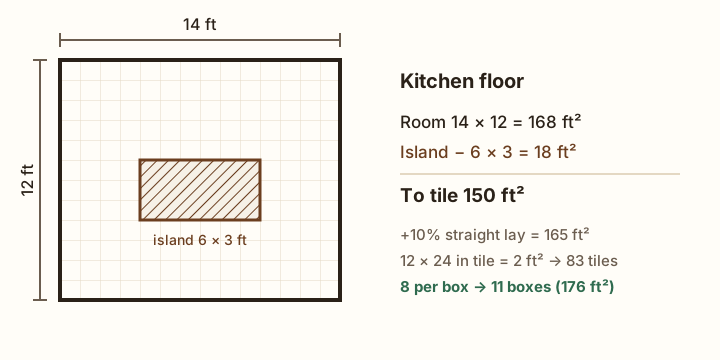
14 × 12 = 168 ft², minus the island 6 × 3 = 18 ft², leaves 150 ft². A 12 × 24 in tile covers 2 ft². With 10% overage: 150 × 1.10 = 165 ft² ÷ 2 = 82.5, so 83 tiles, and 83 ÷ 8 per box = 10.4, so 11 boxes (88 tiles, 176 ft²). At a hypothetical $3.49/ft², the per-foot math says 165 × 3.49 = $575.85, but you pay for 11 whole boxes: 176 × 3.49 = $614.24. That gap is why the calculator prices whole packages.
Backyard sod
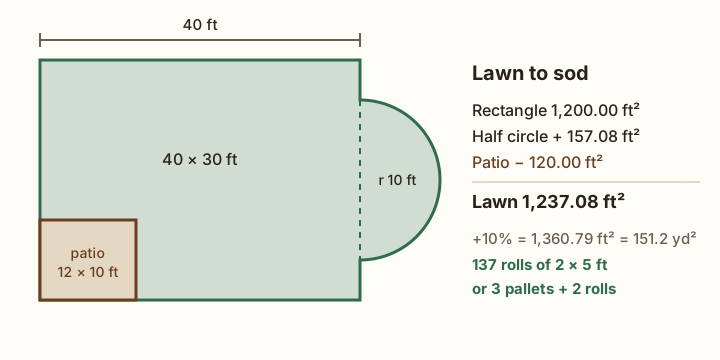
A 40 × 30 ft rectangle (1,200 ft²) plus a half circle of radius 10 ft (π × 10² ÷ 2 = 157.08 ft²) minus a 12 × 10 ft patio (120 ft²) = 1,237.08 ft². Add 10%: 1,360.79 ft², which is 151.2 yd² (÷ 9). In 10 ft² rolls that is 137 rolls; in 450 ft² pallets it is 3 pallets plus 2 rolls (or 4 whole pallets if the farm will not break one). In 16 × 24 in slabs it is 511 slabs.
Ceiling paint
A 14 × 12 ft ceiling is 168 ft². Two coats at 350 ft² per gallon: 168 × 2 ÷ 350 = 0.96, so 1 gallon. Textured or bare drywall drinks more, so read the coverage on your can.
Price per square foot, both ways
Forward: price per ft² × area = cost. Backward: total price ÷ area = price per ft², which is how you compare listings or quotes. A $412,000 house of 1,850 ft² works out to $222.70/ft²; a $455,000 house of 2,100 ft² is $216.67/ft². The bigger, more expensive house is the cheaper one per foot. The price box in the calculator takes two quotes, A and B, and says which is cheaper per square foot; leave area A empty and it uses your project total. For materials it shows the cost two ways, by area and on whole packages, plus the effective price per ft² of floor.
Do not order flooring from the listing number. Under ANSI Z765, house square footage is measured from the outside, including the walls and cladding, below-grade finished space is reported separately, and low sloped ceilings are excluded. Walls, stairs and closets you will not floor are all inside that figure. The price per square foot guide covers homes and contractor quotes.
Square feet and square meters
The international foot is exactly 0.3048 m (NIST retired the old US survey foot for new work), so 1 ft² = 0.09290304 m² and 1 m² = 10.7639 ft². On a big job, rounding to 10.76 costs you: 1,000 m² comes out almost 4 ft² short. A 4 × 3 m room is 12 m² = 129.17 ft².
| m² | ft² | ft² | m² |
|---|---|---|---|
| 1 | 10.76 | 100 | 9.29 |
| 10 | 107.64 | 500 | 46.45 |
| 100 | 1,076.39 | 1,000 | 92.90 |
Mistakes I see on almost every job
- Buying exactly the measured area. Cuts and breakage eat 10–20% depending on the layout.
- Rounding boxes down, or budgeting per square foot when the store sells whole boxes.
- Forgetting to subtract the island, tub or patio, or forgetting the closets and door openings that do get flooring.
- Writing 12 ft 6 in as 12.6 ft.
- Ordering from the listing's square footage instead of a tape measure.
- Buying more tile on a second trip from a different dye lot.
- Ordering sod pallets without asking the farm what a pallet covers.
Why I trust the square foot calculator's math
Every unit is derived from 0.3048 m per foot, so cm, mm, yards, meters and acres (43,560 ft²) all agree to the last decimal: 10,000 cm × 10,000 cm comes out as 107,639.1 ft². Results show two decimals; package counts always round up. Negative or non-numeric sizes get an inline error and no result instead of being quietly squared into a positive area, and a cut-out larger than its room is flagged. Border strips are computed as true constant-width bands (the inner L keeps its notch, the inner triangle shrinks around its incircle), and a border that can only be approximated is labelled as such. Everything runs in your browser with no server: the project list autosaves on your device, you can save named projects, copy the shopping list, or copy a share link that holds the whole project in the part of the address after the # sign. Reset takes two clicks, so one slip cannot wipe a job. Before release the tool is checked against hand-computed cases like these:
| Input | Expected result |
|---|---|
| Rectangle 12 ft 6 in × 11 ft 3 in | 140.63 ft² = 13.06 m² = 15.63 yd² |
| Rectangle 4 × 3 m | 12 m² = 129.17 ft² |
| Circle, diameter 10 ft | 78.54 ft² |
| L 20 × 15 ft minus 8 × 6 ft; border 1 ft | 252 ft²; border 66 ft² |
| Triangle, sides 13, 14, 15 ft | 84 ft² |
| Isosceles triangle, base 10 ft, height 10 ft; border 1 ft | border 27.12 ft² |
| Ring, outer diameter 20 ft; border 3 ft | 160.22 ft² |
| 14 × 12 ft minus island 6 × 3; 12 × 24 in tile, 8 per box, 10% | 150 ft² → 83 tiles → 11 boxes (88 tiles, 176 ft²) |
| The same kitchen at $3.49/ft² | $575.85 by area, $614.24 on 11 whole boxes |
| Rectangle −10 × −12 ft | rejected with an error, no result |
Quick answers
How many square feet is a 12 by 12 room?
A 12 × 12 ft room is 144 square feet, or 13.38 m². For flooring with a straight lay, order about 10% more: 158.4 ft², rounded up to whole boxes.
How do you calculate square feet with inches?
Turn the inches into a fraction of a foot by dividing by 12, then multiply. 12 ft 6 in × 11 ft 3 in is 12.5 × 11.25 = 140.63 ft².
How many tiles do I need for 100 square feet?
With 12 × 12 in tiles (1 ft² each) and 10% overage, 110 tiles; with 12 × 24 in tiles (2 ft² each), 55 tiles. Then divide by tiles per box and round up.
How much extra tile should I buy for herringbone?
Plan on about 20% for herringbone or chevron, against 10% for a straight lay and 15% for diagonal or small rooms. Buy it all in one order so the dye lot matches.
How many square feet are in a pallet of sod?
A common pallet holds about 50 square yards, or 450 ft², but farms range roughly from 400 to 700 ft². Ask your supplier and enter their number.
How many square feet does a gallon of paint cover?
Most labels say around 350 ft² per gallon for one coat on smooth walls. Two coats on a 168 ft² ceiling need 336 ft² of coverage, so 1 gallon.
Guides
 How many tiles do I need? Tile size, boxes and overage by layoutTile area by size, the four-step count to whole boxes, and 10, 15 or 20 percent overage by layout, with a kitchen floor worked out.6-minute read
 How much sod do I need? Rolls, slabs and pallets per square footSplit the lawn into shapes, subtract the patio, add 10 percent, then count rolls, slabs and pallets, with a 1,237 ft² backyard worked through.6-minute read
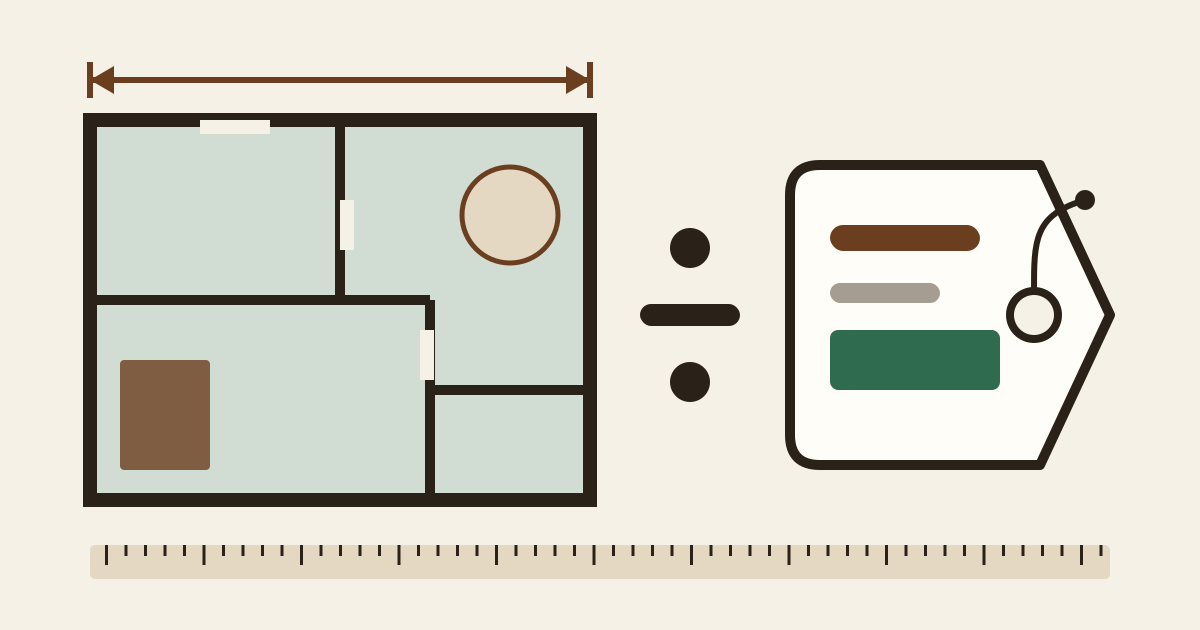 Price per square foot: how to compare homes, flooring and quotesThe formula both ways, what listing square footage includes, and how whole boxes and billed area change flooring and contractor quotes.5-minute read
Updated