How much sod do I need? Rolls, slabs and pallets per square foot
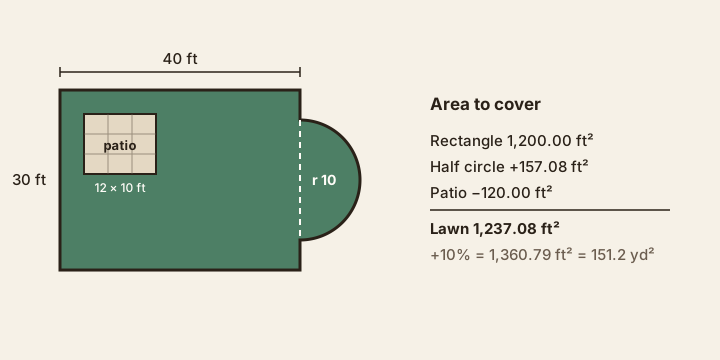
Sod is priced per square yard, stacked on pallets, handed to you in rolls, and measured by you in square feet. Four units for one lawn is how people end up with a pallet too few and a bare strip along the fence. Here is how to turn a sketch of your yard into an order, using a 40 × 30 ft backyard with a curved end and a patio as the running example.
The square foot calculator has a sod option that does the same steps with editable roll, slab and pallet sizes, and shows the result as rolls or slabs, as pallets plus rolls, or as whole pallets if the farm will not break one. The sections below show what it is doing, so you can sanity-check any quote a farm gives you.
Measure the lawn by splitting it into shapes
Purdue Extension's guide to starting a lawn from sod says to break an irregular area into rectangles, triangles and circles, work out each, and add them. It also tells you to put walks, drives, beds and buildings on the sketch because they change what you order (Purdue AY-28-W). I do exactly that, on graph paper, before I touch a phone.
- Sketch the yard and the house, fence and every hard edge, roughly to scale.
- Cut it into simple pieces. Rectangles first, then triangles, then half or quarter circles at curved ends.
- Measure each piece with a tape or wheel and write feet and inches as decimals: 8 ft 6 in is 8.5 ft.
- Add the pieces, then subtract everything that will not get turf: patio, planting beds, a tree ring, the path to the shed.
| Shape | Formula | Example |
|---|---|---|
| Rectangle | length × width | 40 × 30 = 1,200 ft² |
| Triangle | ½ × base × height | ½ × 20 × 8 = 80 ft² |
| Circle | π × radius² | π × 10² = 314.16 ft² |
| Half circle | ½ × π × radius² | 157.08 ft² |
Slopes: a tape laid on a steep bank reads the true surface, which is larger than the flat plan view. A gentle slope is covered by the extra 10 percent; on a steep bank, measure along the ground and add a little more.
Square feet, square yards, rolls, slabs and pallets
Farms and garden centres quote in square yards, which is simply square feet divided by 9. Packaging differs by supplier, so treat these as starting values and ask for the real ones.
| Unit | Typical size | Covers |
|---|---|---|
| Square yard | 3 ft × 3 ft | 9 ft² |
| Roll | 2 ft × 5 ft | 10 ft² |
| Slab (square piece) | 16 in. × 24 in. | 2.67 ft² |
| Pallet | varies by farm | about 450 ft² (50 yd²), commonly 400 to 700 ft² |
Purdue gives about 50 square yards, or 450 ft², for a pallet. I treat that as a placeholder. Pallet sizes differ between farms and between grass types, and the number on the order form is the only one that counts.
Add 10 percent, then round up to whole units
Purdue suggests ordering roughly 10 percent more than you measured to allow for cutting around corners and edges and for measuring errors. It is a sensible default: curved edges, irregular beds and a lawn that is not truly rectangular all eat sod.
Round up at the unit you actually receive. If you buy rolls, round up to whole rolls. If you buy by pallet, round up to whole pallets, and decide separately whether to top up with a few rolls.
Worked example: the backyard
| Step | Calculation | Result |
|---|---|---|
| Rectangle | 40 × 30 | 1,200 ft² |
| Half circle, radius 10 ft | ½ × π × 10² | +157.08 ft² |
| Patio | 12 × 10 | −120 ft² |
| Lawn area | 1,200 + 157.08 − 120 | 1,237.08 ft² |
| Plus 10% | 1,237.08 × 1.10 | 1,360.79 ft² = 151.2 yd² |
| Rolls | 1,360.79 ÷ 10 = 136.1 | 137 rolls |
| Slabs | 1,360.79 ÷ 2.667 = 510.3 | 511 slabs |
| Pallets of 450 ft² | 1,360.79 ÷ 450 = 3.02 | 3 pallets + 2 rolls |
Three 450 ft² pallets cover 1,350 ft², which is 10.79 ft² short of the 1,360.79 you need. Two more rolls close the gap, for 1,370 ft² in total. That is why I never round 3.02 down to 3 and call it done.
A smaller lawn, quickly
A front yard measures 25 ft × 20 ft with a 3 ft × 15 ft walk through it. That is 500 − 45 = 455 ft². With 10 percent it becomes 500.5 ft², or 55.6 yd². At 10 ft² a roll, 500.5 ÷ 10 = 50.05, so you order 51 rolls. Notice how close that came to 50: a single extra square foot in the sketch would not have changed the order, but a missed walk would have changed it by five rolls.
Pallet size changes the order
Run the same yard against different pallet sizes and the answer shifts. Whether to take one more pallet or fill with rolls is a price and delivery question for your farm.
| Pallet size | Full pallets | Left over | Rolls to fill | Or whole pallets |
|---|---|---|---|---|
| 400 ft² | 3 | 160.79 ft² | 17 | 4 |
| 450 ft² | 3 | 10.79 ft² | 2 | 4 |
| 500 ft² | 2 | 360.79 ft² | 37 | 3 |
| 600 ft² | 2 | 160.79 ft² | 17 | 3 |
| 700 ft² | 1 | 660.79 ft² | 67 | 2 |
Reading a farm's price
A price per square yard converts to square feet by dividing by 9. A hypothetical $4.50 per yd² is $0.50 per ft². Delivery, a pallet deposit or a minimum order can matter more than a few cents either way, so compare the all-in total for the same covered area, the way the price per square foot guide compares quotes.
Delivery day
Sod is alive and stacked tight, so it heats up on the pallet. My rule is to have the soil graded and raked before the truck arrives, lay it the day it is delivered, and follow the farm's watering instructions. Order for a time you can actually work, not for a week you are away.
Tiling the patio in the same project? Work out the boxes with how many tiles you need, and subtract that area from the lawn before you order.
Quick answers
How many square feet are in a pallet of sod?
A pallet is typically about 450 ft² (50 square yards), but farms vary, commonly from 400 to 700 ft². Ask your supplier for its pallet size before you order.
How do I convert square feet to square yards for sod?
Divide square feet by 9. A lawn of 1,360 ft² is about 151 square yards.
How much extra sod should I order?
Order about 10 percent more than you measured to cover cuts at corners and edges and small measuring errors. Curved edges and irregular beds can need a little more.
How many rolls of sod cover 1,000 square feet?
A 2 ft × 5 ft roll covers 10 ft², so 1,000 ft² needs 100 rolls, or 110 rolls with the 10 percent allowance.
How should I measure an irregular lawn?
Split it into rectangles, triangles and circles, calculate each, add them and subtract walks, beds, patios and buildings that will not get sod.