How many tiles do I need? Tile size, boxes and overage by layout
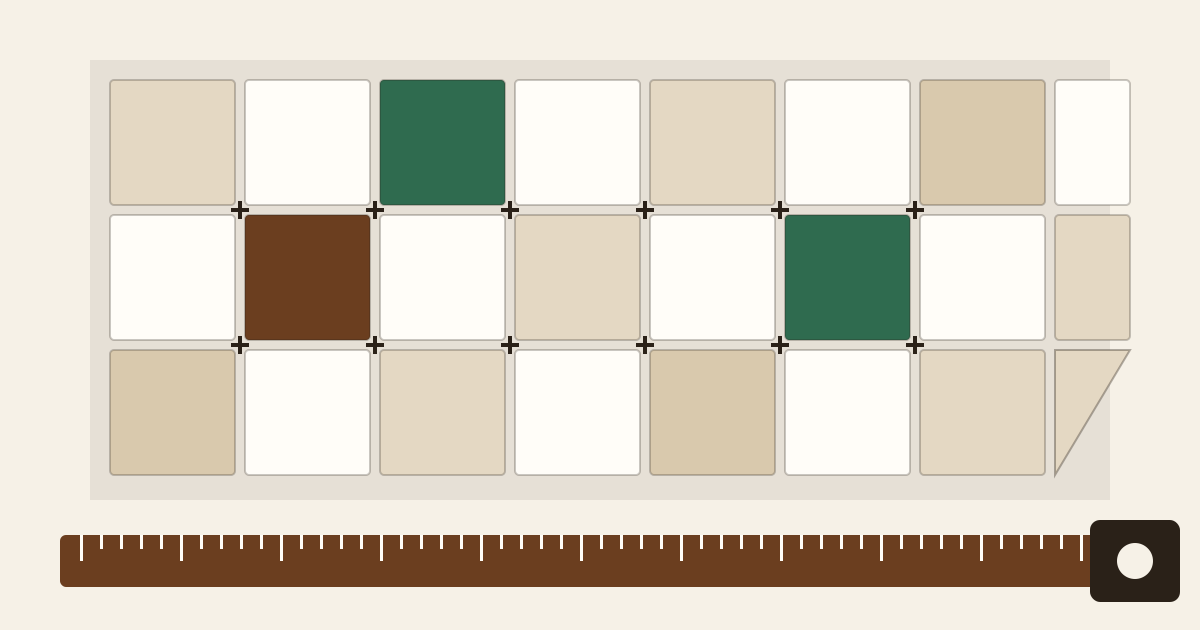
You measured the kitchen floor at 150 square feet, the store sells 12×24 in. tiles in boxes of eight, and now you have to decide how many boxes go in the cart. Work it in four moves: tile area, floor area, overage for your layout, then round up to whole boxes. The kitchen below ends at 11 boxes, not the 10.4 you would get by dividing and hoping.
Every number here matches the square foot calculator, so you can check a room on your phone while you stand in it. Its tile option counts tiles first and boxes second, and shows the cost both by area and on the whole boxes you actually pay for. The rest of this page is the reasoning behind the numbers, because the right overage depends on the layout and the room, not on a single rule.
Start with the floor you will actually tile
Tape from wall to wall, not from the face of one cabinet to the other. Write every length in feet and inches, then convert: 12 ft 6 in is 12.5 ft, never 12.6. I carry a sketch and split any odd room into rectangles, measure each, and add them.
- Count in: closets, alcoves, the doorway threshold zone, and the strip under a toe-kick you may pull later.
- Count out: a kitchen island, a tub or shower pan that stays, a fireplace hearth you will not tile, built-in cabinets that sit on the subfloor.
- Check twice: a room that looks square is rarely square. Measure both opposite walls and use the larger pair.
Tile area by size
Area per tile is length times width, in the same unit. Most US sizes are named in inches, so divide square inches by 144 to get square feet. Metric tiles are named in centimetres; multiply the two sides in metres.
| Tile size | Area per tile | Tiles per 100 ft² (no overage) |
|---|---|---|
| 3×6 in. subway | 0.125 ft² | 800 |
| 4×12 in. | 0.333 ft² | 300 |
| 12×12 in. | 1 ft² | 100 |
| 6×24 in. plank | 1 ft² | 100 |
| 12×24 in. | 2 ft² | 50 |
| 24×24 in. | 4 ft² | 25 |
| 30×60 cm | 0.18 m² (1.94 ft²) | 51.6 |
| 60×60 cm | 0.36 m² (3.88 ft²) | 25.8 |
The four-step tile count
- Floor area. Add the rectangles, subtract what stays untiled.
- Add overage. Multiply by 1.10, 1.15 or 1.20 depending on the layout (next section).
- Divide by the area of one tile and round up to a whole tile.
- Divide by tiles per box and round up again. Boxes cannot be split at the register.
If the carton states coverage in square feet instead of a tile count, skip steps 3 and 4: boxes = ceil(area × (1 + overage) ÷ coverage per box). The two routes agree when the carton coverage equals tiles per box times tile area.
Overage: how much extra, and why
A tile maker's own sizing help defaults to 15 percent and gives three reasons for it: cuts at walls and fixtures, 2 to 4 percent breakage in shipping and handling, and a few spares for repairs later (Clé Tile help). I use a sliding scale that follows the cuts the layout creates.
| Layout | Overage | Why |
|---|---|---|
| Straight lay, large simple room | 10% | Few cuts, offcuts often reusable at the opposite wall |
| Diagonal, offset, small or broken-up room | 15% | Every border tile is cut, and most offcuts are too short to reuse |
| Herringbone or chevron | 20% | Angled ends at every wall plus pattern waste |
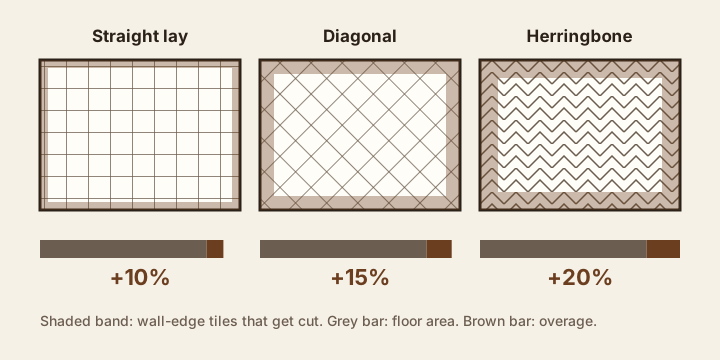
Rule of thumb: go to the next step up when the room is under about 40 ft², has lots of corners, or uses large-format tiles. A 24×24 in. tile that breaks takes 4 ft² of floor with it.
Worked example: kitchen floor
A kitchen measures 14 ft × 12 ft with a 6 ft × 3 ft island that sits on the slab. The tile is 12×24 in. (2 ft²) with 8 tiles per box, laid straight with 10 percent overage.
| Step | Calculation | Result |
|---|---|---|
| Room | 14 × 12 | 168 ft² |
| Island | 6 × 3 | −18 ft² |
| Floor to tile | 168 − 18 | 150 ft² |
| With 10% overage | 150 × 1.10 | 165 ft² |
| Tiles | 165 ÷ 2 = 82.5 | 83 tiles |
| Boxes | 83 ÷ 8 = 10.4 | 11 boxes |
Eleven boxes hold 88 tiles, which cover 176 ft². The five tiles beyond the 83 you counted are your attic stock. If the 10.4 had come out as 10.0 exactly I would still add a box when the pattern is diagonal, because the real risk is a bad cut on the last row, not the arithmetic.
What it costs on whole boxes
With a hypothetical shelf price of $3.49 per ft², paying for the 165 ft² you calculated would be $575.85. The store charges for the 176 ft² in 11 boxes: $614.24. That is $4.09 for each of the 150 ft² you tiled. Budget with the box figure, not the area figure.
Grout joints, walls and metric rooms
- Grout joints: a 12-inch tile with a 3/16 in. joint occupies 12.1875 in. of floor, about 3 percent more area than its face. A 1/16 in. joint gives about 1 percent. Ignore it when ordering; it is free margin inside your overage, not a reason to cut the overage.
- Backsplash and walls: area is width times height, minus outlets and window openings larger than a hand. A 12 ft run, 18 in. high, is 18 ft². In 3×6 in. subway tile with 10 percent: 19.8 ft² ÷ 0.125 = 158.4, so 159 tiles. Sheets and trim pieces are sold separately.
- Metric rooms: a 4 m × 3 m floor is 12 m². In 30×60 cm tiles at 10 percent: 13.2 m² ÷ 0.18 = 73.3, so 74 tiles.
- Quick count for 100 ft²: at 10 percent that is 110 ft², so 110 tiles of 12×12 in., 55 of 12×24 in., or 28 of 24×24 in.
Buy the overage in the same order
Tile is fired in batches, and colour and size drift a little from one batch to the next. Cartons carry a dye lot or shade number. Buy every box you need, overage included, in one order, and check that the numbers on the cartons match before you leave the store. Returning unopened boxes is usually easier than hunting for a matching lot a year later.
Keep two or three spare tiles and the carton label. When a heavy pan chips one, you will thank yourself. If the same job includes turf outside, see how much sod you need, and when the quotes come in, price per square foot shows how to compare them on the same area.
Quick answers
How many tiles do I need for 100 square feet?
With 10 percent overage you need 110 ft² of tile: 110 tiles of 12×12 in., 55 of 12×24 in. or 28 of 24×24 in. Use 115 ft² for a diagonal layout and 120 ft² for herringbone.
How much extra tile should I buy?
Add 10 percent for a straight lay in a large simple room, 15 percent for diagonal layouts or small rooms with many cuts, and 20 percent for herringbone or chevron.
Do I count grout lines when ordering tile?
No. A joint adds only 1 to 3 percent to the floor a tile covers, and that small gain is absorbed by the overage you already add for cuts and breakage.
Should I round up the number of tiles or the number of boxes?
Both. Round the tile count up to a whole tile, divide by tiles per box, then round that up to whole boxes. The extra tiles in the last box are your spare stock.
Why do I need to buy all the tile at once?
Tiles from different production batches can differ slightly in colour and size. Buying the overage in the same order keeps every box in the same dye lot.